What is Apple Developer Academy
Apple developer academy is an intensive 10-month program focused on designing, developing, and shipping native applications across iOS, watchOS, and macOS. And Im so proud that I was selected of 100 cohort learners from 13,000+ applicants (<1% acceptance rate) to join the Apple Developer Academy at Infinite Learning in Batam.
What I Learn Here
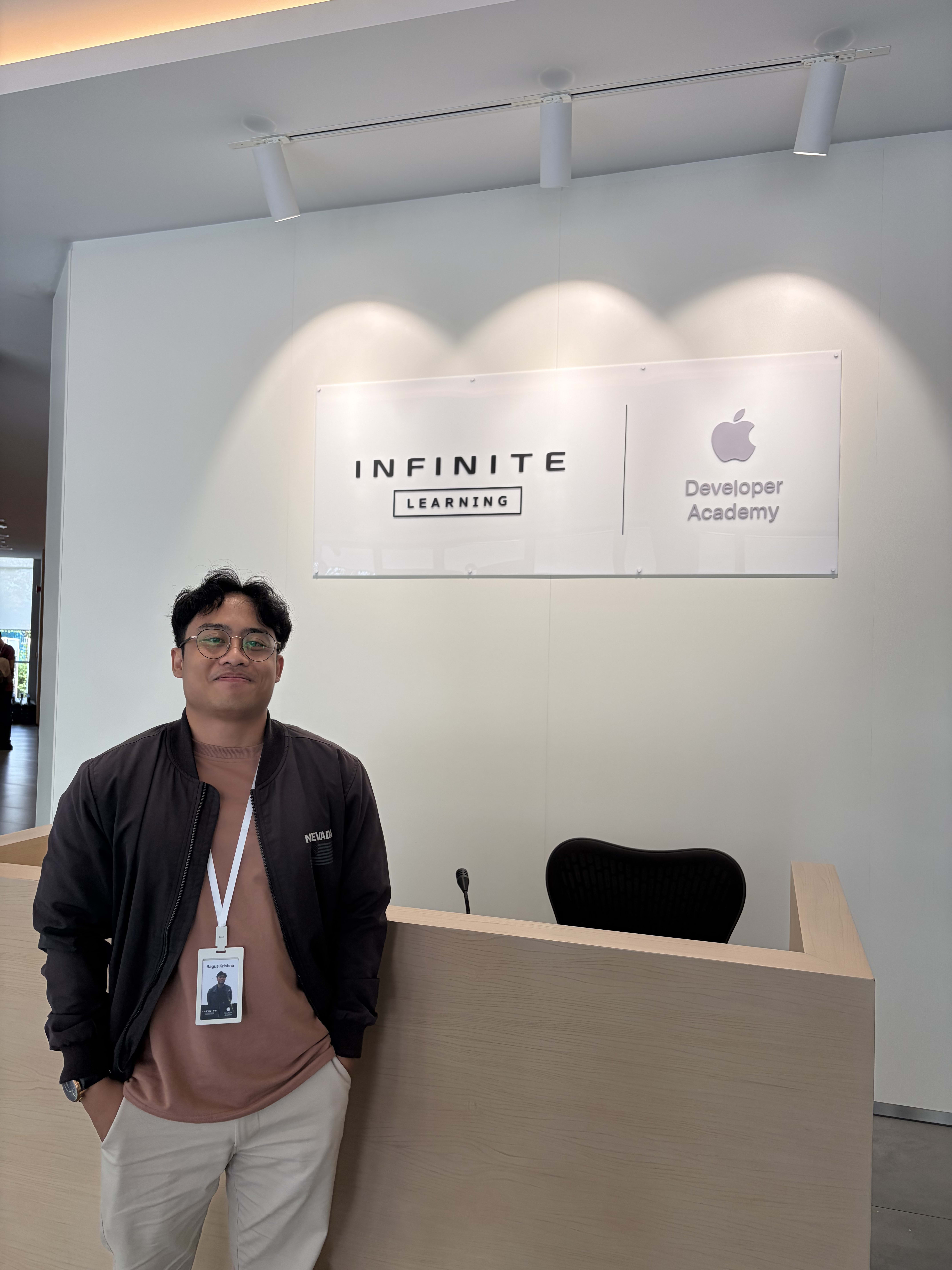
Learning at the Academy follows Apple's Challenge-Based Learning (CBL) framework through three phases: Engage, Investigate, and Act. Rather than working in a developer-only silo, I collaborate in multidisciplinary teams pairing developers, UI/UX designers, and user researchers.
The most significant shift in my engineering approach was focusing on on-device intelligence. I learned to leverage Swift, CoreML, and the Apple Neural Engine to run machine learning models locally on the device, maintaining user privacy without sending raw personal data to cloud servers while keeping performance real-time.
The Challenges
Challenge 1: KoalaFit (watchOS Workout Companion)
I investigated why people abandon fitness habits within their first few weeks. Static progress bars and generic calorie rings often feel impersonal and easy to neglect. I developed KoalaFit, an independent watchOS workout app featuring an interactive digital avatar that responds to exercise consistency in real time via Apple HealthKit.
Challenge 2: WattWise (Rusun Electricity Budget Manager)
When I moved to Batam for the Academy, sharing a flat (rusunawa) with a roommate revealed a constant headache: trying to save electricity on our prepaid PLN token while appliances ran unchecked and drained the units early. We found fellow learners across the rusun had the exact same friction. I built the budgeting logic and UI in SwiftUI using MVVM architecture to calculate and distribute daily appliance power limits.
Challenge 3: Footsal (Real-Time Smart Sports Ball Analytics)
We wanted to provide match analytics for amateur futsal communities without requiring expensive multi-camera stadium setups. I developed Footsal to turn an iPhone placed on a sideline tripod into a live tracking assistant, converting a YOLO11m model to CoreML and connecting it with Apple's Vision framework for real-time frame-by-frame ball tracking.
Challenge 4: RONA (AI Acne Detection & Recovery Tracker)
In a 10-person multidisciplinary team, we addressed how difficult it is to track acne recovery objectively while keeping photos private. I led the machine learning pipeline and iOS integration, training and quantizing a YOLO26s model to a 9.3 MB INT8 CoreML package that runs entirely offline on the Apple Neural Engine to evaluate three-angle face scans.
Challenge 5: Arterious (Family Health Monitoring iOS App)
We addressed how adult children can stay informed about aging parents' health conditions across distance without intrusive surveillance. I developed the health monitoring architecture in Swift 6 and SwiftUI, integrating Apple HealthKit to read biometrics (Heart Rate, Resting HR, HRV, Sleep, Steps), CloudKit for private family data syncing, and Google Gemini API for structured, non-diagnostic wellness trend summaries and gentle conversation starters.
Tech Stack & Skills
- Swift 6
- SwiftUI
- CoreML
- Vision Framework
- HealthKit
- CloudKit
- Gemini API
- YOLO26s
- PyTorch
- Python